

Paris, 16 april 2025
April 29 to May 1 | National Palace of Mafra, Palácio dos Marqueses, Francisco Alves Gato Music House, Beatriz Costa Auditorium. Under the High Patronage of Marcelo Rebelo de Sousa, President of the Portuguese Republic, and Emmanuel Macron, President of the French Republic, the Mafra Days 2025 affirm, from Portugal, the essential role of music in building a more united, plural, and peaceful Europe. More than ever in the past 80 years, Europe is facing serious threats orchestrated by engineers of chaos, and we must call upon music for its power to generate and share the common good. Urgent action is needed.
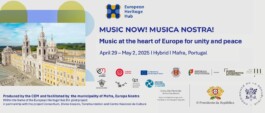
Music Now! Musica Nostra ! est une manière de renforcer notre solidarité pour former une nouvelle génération d’ingénieurs du bien commun et protéger notre patrimoine culturel en tant qu’Européens.
Pendant trois jours, le Palais National de Mafra — monument emblématique du baroque ibérique et siège du Centre Européen de Musique (CEM Portugal) — accueille une rencontre européenne sans précédent, réunissant artistes, créateurs, institutions culturelles, chercheurs, décideurs politiques et partenaires stratégiques de tout le continent.
Organisées par le Centre Européen de Musique, avec ses pôles du Portugal, de la France, de l’Espagne, de l’Italie et de l’Autriche, et en partenariat étroit avec la municipalité de Mafra, Europa Nostra, le European Heritage Hub, la Terrafoundation, l’association Divino Sospiro et le Centre National de la Culture, ces journées représentent une impulsion culturelle et politique forte, reconnaissant la musique comme patrimoine commun, force de civilisation et langage universel de rencontre et d’avenir.
MANIFESTO
MUSIC NOW!, MUSICA NOSTRA!
For a Europe that listens, inspires and acts through music
Europe was born from a breath.
The breath of ideas, struggles, and the arts. The breath of music too that intimate and universal voice that spans centuries, crosses borders, and makes peoples resonate.
But today, that breath is fading. Too often, music is confined to entertainment or sidelined from public policies. Yet music is much more than a cultural sector. It is a language, a remedy, a tool for peace, a space for memory and vision. It is the vibrant soul of a humanist European project.
This manifesto is a call. A call to recognise the cross-cutting value of music across all dimensions of human life: education, health, ecology, inclusion, innovation, democracy. A call to do better, and to do differently. To place music back at the heart of Europe’s social and cultural pact.
We begin with a conviction: current policies, though numerous and at times ambitious, are no longer enough. Yes, initiatives exist: Creative Europe, Music moves Europe, the New European Bauhaus, programmes for youth, heritage, mental health. But they are too fragmented. Too sectoral. They do not fully embrace what music can offer in transforming our societies.
We propose to make music a driving force for change.
In the light of the 2030 Agenda and the major challenges of our time climate transition, social fragmentation, identity uprooting, the rise of extremism, music can become a sensitive and a sensible compass. A path to restore listening, harmony, cohesion. A way to build a Europe that remains true to its values and shows leadership in times of crisis.
The pilot project carried by the Centre Européen de Musique (CEM) with the support of the European Heritage Hub and our main partner Europa Nostra shows the way. By placing music at the centre of civic life, heritage, education, innovation, and diplomacy, it demonstrates that it is possible to act differently, sustainably, humanely. It also reveals that music has always been there, yet we have not listened enough. It is time to truly listen and give music an active role in rethinking Europe.
This manifesto calls for a renewed alliance between civil society and European institutions. An alliance capable of transforming how we shape public policies. The European parliamentary initiative report, co-written with the CEM, must become a catalyst for change. This is no longer about defending music: it’s about giving it the power to act for the common good.
This requires concrete actions. It means:
• making music a tool forpublic health, especially mental health and active ageing;
• embedding music in inclusive and creative education, from early childhood;
• using music as a lever for social inclusion, for refugees and marginalised groups;
• integrating music into climate transition policies, to rebuild our sensitive connection to nature;
• strengthening European diplomacy through music as a universal language;
• investing in innovation for a human-centred and culturally and ethically conscious AI;
• supporting musical creation in rural and peripheral territories;
• addressing isolation, violence and meaning through musical engagement.
Because not investing in music does not only mean losing GDP points for decades. It’s even more serious than that. It’s burying an open, mobile and creative Europe. It’s leaving the world in the hands of those who destroy what they do not understand, those who ignore what matters and chase only short-term gain.
Yet even in the short term, music has the power to change the world.
It already does wherever we let it speak. Today, Europe can and must lead the way.
It must become the continent of resonance, of connection, of listening.
To give voice. To dare to sing. To open the ears of the polis.
Music Agora ! Music Now ! Musica Nostra !
Trois jours, une seule voix : l’Europe qui se reconnaît dans la musique
29 avril – VIA SCARLATTI : L’Europe des Arts et de l’Innovation
Consacrée au programme VIA SCARLATTI | La culture et l’innovation comme âme de l’Europe, la journée débute par un atelier créatif autour du projet “Passarola – variations musicales sur le passé et le futur” et marque la réunion inaugurale du Think Tank International VIA SCARLATTI, avec des représentants des cinq pôles du CEM et des invités internationaux, proposant une réflexion transdisciplinaire entre musique, sciences, humanités et technologie.
À 21h30, l’auditorium Francisco Alves Gato accueille la présentation du programme VIA SCARLATTI avec les pianistes Shani Diluka, Isabel Dobarro et Pedro Emanuel Pereira.
30 avril – Mafra est Musique, l’Europe est Musique
Avec la présence du European Heritage Hub, d’Europa Nostra, de députés européens et d’institutions de l’Union européenne, cette journée réaffirme la centralité de la musique comme bien commun européen.
Temps forts :
1er mai – L’Europe des Musiciens
La dernière journée accueille la rencontre du Réseau des Maisons et Musées de Musiciens Européens, favorisant le dialogue entre mémoire et création.
À 21h00, projection publique du documentaire “Une Saga Culturelle”, de Nadège de Peganow, produit par ARTE, Bel Air Media, le CEM et le CEEH. Le film retrace la naissance d’une conscience culturelle européenne au XIXe siècle à travers les figures visionnaires de Pauline Viardot, Louis Viardot et Ivan Tourgueniev.
Mafra : Capitale Européenne de la Musique et de l’Espoir
Plus qu’un événement, les Journées de Mafra sont une déclaration politique et poétique : l’Europe a besoin de la musique pour se comprendre et se transformer. Du legs de Domenico Scarlatti — voyageur entre l’Italie, le Portugal, l’Espagne et la France — à l’innovation contemporaine des créateurs et penseurs d’aujourd’hui, le programme réaffirme le rôle fondamental de la culture dans l’Europe de demain — une Europe unie dans sa diversité, vivante dans son patrimoine et consciente de sa mission de paix.
Pendant ces jours, Mafra sera le cœur vibrant de l’Europe. Et la musique, son langage commun.
Pour plus d’informations : jornadasdemafra@cemusique.com
Paris, 16 april 2025
April 29 to May 1 | National Palace of Mafra, Palácio dos Marqueses, Francisco Alves Gato Music House, Beatriz Costa Auditorium. Under the High Patronage of Marcelo Rebelo de Sousa, President of the Portuguese Republic, and Emmanuel Macron, President of the French Republic, the Mafra Days 2025 affirm, from Portugal, the essential role of music in building a more united, plural, and peaceful Europe. More than ever in the past 80 years, Europe is facing serious threats orchestrated by engineers of chaos, and we must call upon music for its power to generate and share the common good. Urgent action is needed.
Music Now! Musica Nostra ! est une manière de renforcer notre solidarité pour former une nouvelle génération d’ingénieurs du bien commun et protéger notre patrimoine culturel en tant qu’Européens.
Pendant trois jours, le Palais National de Mafra — monument emblématique du baroque ibérique et siège du Centre Européen de Musique (CEM Portugal) — accueille une rencontre européenne sans précédent, réunissant artistes, créateurs, institutions culturelles, chercheurs, décideurs politiques et partenaires stratégiques de tout le continent.
Organisées par le Centre Européen de Musique, avec ses pôles du Portugal, de la France, de l’Espagne, de l’Italie et de l’Autriche, et en partenariat étroit avec la municipalité de Mafra, Europa Nostra, le European Heritage Hub, la Terrafoundation, l’association Divino Sospiro et le Centre National de la Culture, ces journées représentent une impulsion culturelle et politique forte, reconnaissant la musique comme patrimoine commun, force de civilisation et langage universel de rencontre et d’avenir.
MANIFESTO
MUSIC NOW!, MUSICA NOSTRA!
For a Europe that listens, inspires and acts through music
Europe was born from a breath.
The breath of ideas, struggles, and the arts. The breath of music too that intimate and universal voice that spans centuries, crosses borders, and makes peoples resonate.
But today, that breath is fading. Too often, music is confined to entertainment or sidelined from public policies. Yet music is much more than a cultural sector. It is a language, a remedy, a tool for peace, a space for memory and vision. It is the vibrant soul of a humanist European project.
This manifesto is a call. A call to recognise the cross-cutting value of music across all dimensions of human life: education, health, ecology, inclusion, innovation, democracy. A call to do better, and to do differently. To place music back at the heart of Europe’s social and cultural pact.
We begin with a conviction: current policies, though numerous and at times ambitious, are no longer enough. Yes, initiatives exist: Creative Europe, Music moves Europe, the New European Bauhaus, programmes for youth, heritage, mental health. But they are too fragmented. Too sectoral. They do not fully embrace what music can offer in transforming our societies.
We propose to make music a driving force for change.
In the light of the 2030 Agenda and the major challenges of our time climate transition, social fragmentation, identity uprooting, the rise of extremism, music can become a sensitive and a sensible compass. A path to restore listening, harmony, cohesion. A way to build a Europe that remains true to its values and shows leadership in times of crisis.
The pilot project carried by the Centre Européen de Musique (CEM) with the support of the European Heritage Hub and our main partner Europa Nostra shows the way. By placing music at the centre of civic life, heritage, education, innovation, and diplomacy, it demonstrates that it is possible to act differently, sustainably, humanely. It also reveals that music has always been there, yet we have not listened enough. It is time to truly listen and give music an active role in rethinking Europe.
This manifesto calls for a renewed alliance between civil society and European institutions. An alliance capable of transforming how we shape public policies. The European parliamentary initiative report, co-written with the CEM, must become a catalyst for change. This is no longer about defending music: it’s about giving it the power to act for the common good.
This requires concrete actions. It means:
• making music a tool forpublic health, especially mental health and active ageing;
• embedding music in inclusive and creative education, from early childhood;
• using music as a lever for social inclusion, for refugees and marginalised groups;
• integrating music into climate transition policies, to rebuild our sensitive connection to nature;
• strengthening European diplomacy through music as a universal language;
• investing in innovation for a human-centred and culturally and ethically conscious AI;
• supporting musical creation in rural and peripheral territories;
• addressing isolation, violence and meaning through musical engagement.
Because not investing in music does not only mean losing GDP points for decades. It’s even more serious than that. It’s burying an open, mobile and creative Europe. It’s leaving the world in the hands of those who destroy what they do not understand, those who ignore what matters and chase only short-term gain.
Yet even in the short term, music has the power to change the world.
It already does wherever we let it speak. Today, Europe can and must lead the way.
It must become the continent of resonance, of connection, of listening.
To give voice. To dare to sing. To open the ears of the polis.
Music Agora ! Music Now ! Musica Nostra !
Trois jours, une seule voix : l’Europe qui se reconnaît dans la musique
29 avril – VIA SCARLATTI : L’Europe des Arts et de l’Innovation
Consacrée au programme VIA SCARLATTI | La culture et l’innovation comme âme de l’Europe, la journée débute par un atelier créatif autour du projet “Passarola – variations musicales sur le passé et le futur” et marque la réunion inaugurale du Think Tank International VIA SCARLATTI, avec des représentants des cinq pôles du CEM et des invités internationaux, proposant une réflexion transdisciplinaire entre musique, sciences, humanités et technologie.
À 21h30, l’auditorium Francisco Alves Gato accueille la présentation du programme VIA SCARLATTI avec les pianistes Shani Diluka, Isabel Dobarro et Pedro Emanuel Pereira.
30 avril – Mafra est Musique, l’Europe est Musique
Avec la présence du European Heritage Hub, d’Europa Nostra, de députés européens et d’institutions de l’Union européenne, cette journée réaffirme la centralité de la musique comme bien commun européen.
Temps forts :
1er mai – L’Europe des Musiciens
La dernière journée accueille la rencontre du Réseau des Maisons et Musées de Musiciens Européens, favorisant le dialogue entre mémoire et création.
À 21h00, projection publique du documentaire “Une Saga Culturelle”, de Nadège de Peganow, produit par ARTE, Bel Air Media, le CEM et le CEEH. Le film retrace la naissance d’une conscience culturelle européenne au XIXe siècle à travers les figures visionnaires de Pauline Viardot, Louis Viardot et Ivan Tourgueniev.
Mafra : Capitale Européenne de la Musique et de l’Espoir
Plus qu’un événement, les Journées de Mafra sont une déclaration politique et poétique : l’Europe a besoin de la musique pour se comprendre et se transformer. Du legs de Domenico Scarlatti — voyageur entre l’Italie, le Portugal, l’Espagne et la France — à l’innovation contemporaine des créateurs et penseurs d’aujourd’hui, le programme réaffirme le rôle fondamental de la culture dans l’Europe de demain — une Europe unie dans sa diversité, vivante dans son patrimoine et consciente de sa mission de paix.
Pendant ces jours, Mafra sera le cœur vibrant de l’Europe. Et la musique, son langage commun.
Pour plus d’informations : jornadasdemafra@cemusique.com







Playlist